Christian Oertel[1] was born April 15, 1842 in Dankersen, a village in the city of Minden, which was part of Prussia and presently lies in the northeastern corner of North Rhine-Westphalia in Germany. Christian was baptized two days later in the local Lutheran church. His parents were Johann Friedrich “Frederick” Konrad Oertel and Karoline Charlotte Luise “Louise” Dehrberg. [2] Interestingly, Christian appears to have been born before his parents were married, which did not occur until May 5, 1844.[3] This was shortly before the small family’s immigration to the United States in August.
Frederick, Louise and two-year-old Christian departed from Bremen on the ship Schiller and arrived in the port of Baltimore on August 23, 1844. Their destination was Indiana—a destination that they shared with most of their fellow passengers on the Schiller.[4] Many of the other passengers were also from the Minden area, coming from neighboring villages and towns like Frille, Päpinghausen and Petershagen. Why this large group of regional migrants left Prussia for the U.S. Midwest at this time is not certain, but it is likely that they were pushed and pulled by factors impacting many Germans who immigrated in this time period. In the German kingdoms, many people faced lack of economic opportunity, political instability, the threat of military conscription, overpopulation, famine, and religious persecution. Immigrants were drawn to the U.S. by the promise of opportunity and land which were advertised widely in German newspapers and ads by land agents, and by earlier immigrants who had successfully established themselves in the country and sent word back to their towns of origin.[5] By 1850, the Oertel family was settled in Sugar Creek Township in Hancock County, Indiana, where Frederick engaged in farming. Three children were born in the first six years after the family’s arrival in Indiana: Louisa, Frederick, and Christina.[6]
Hancock County was formed in 1828, but the earliest Euro-American settlement in the area was Blue River Township, settled in 1818. Before the arrival of Euro-American settlers, the region had been a home to several indigenous societies, including the Miami, Delaware, and Potawatomi. By the 1820s, most of the indigenous population had been pushed west by encroaching Euro-American colonization.[7] When the Oertel family arrived, the township of Sugar Creek was populated by a mixture of Americans of colonial descent and Germans. According to John H. Binford’s 1882 county history, “This township far surpasses any other in the county in her reports of the number of foreigners” and “The foreigners in Sugar-creek are mostly Germans, industrious farmers, who have clustered around a little nucleus early planted in the township.”[8] Many of the German immigrants in Sugar Creek came from the Minden area, arriving as early as the late 1820s.[9]
It seems likely that during the family’s first years in the United States, they maintained many practices and activities from their life in Prussia. They lived among compatriots and attended the local German Lutheran Church, so German was probably their primary language of communication.[10] Even by 1900, after more than 50 years of living in the U.S., Louisa Oertel was unable to speak English.[11] Their rural church was probably relatively conservative in beliefs and practices, as the still-existing German Lutheran Church—called Zion Lutheran Church, in New Palestine—is a member of the more conservative Missouri Synod of the Lutheran Church.[12] Children generally attended parochial schools. In general, ties of nationality, language, and religion likely made the small rural community tight-knit and at a certain remove from outside events.

Political Alignment of German Immigrants on the Eve of the Civil War
The Oertel family arrived during an eventful period in U.S. history. In the 1840s, westward migration of Euro-American settlers increased dramatically, which led to a nationwide conflict about the creation of new states and the expansion of slavery into them. This conflict culminated in the Civil War, which began before the family had reached two decades of residence in the country. It is impossible to know exactly what they thought about key issues related to the war, but it is realistic to explore some possibilities about their political stances and views on the conflict.
According to the Hancock County biography of Henry Ortel, Frederick and Louisa’s fifth child, both Henry and his father Frederick were “staunch Democrat[s].”[13] This statement appeared in the county history published in 1916, well after the Civil War period, so it is not known how long the family had supported the Democratic Party. But the statement does point to concrete political tendencies common among Midwestern German Americans in the 19th century—particularly from the 1840s on. While many German immigrants living in urban areas, especially those who were educated and politically involved, supported the Republican Party in the second half of the 19th century, many of their rural farming compatriots supported the Democratic Party due to the Democrats’ proclaimed support for agrarian livelihoods and a hands-off federal government which promised autonomy for rural communities.
More importantly, many newly arrived Germans were suspicious of the nativist, anti-immigrant elements present in the other major political parties of the time like the Whigs, Know Nothings, and later the Republicans. In general, they were also wary of prohibition supporters, who were a vocal presence in some of these political parties. Alcohol consumption was a commonplace activity in German culture, and many immigrants resented attempts to paint it as sinful delinquency. As George H. Daniels demonstrated in his close study of election results in a rural Iowa community with many German immigrant residents, the issues of nativism and prohibition were probably sufficient in and of themselves to encourage some rural immigrant communities to side with the Democratic Party in the mid-1800s.[14] Walter D. Kamphoefner and Wolfgang Helbich also recently stated in their examination of German immigrant soldiers in the Civil War that “Scholars who have examined voting behavior and electoral issues more carefully have concluded that the legacy of nativism in the Republican Party and the anticlerical tendencies of its most articulate German leaders often proved to be insurmountable obstacles with rank-and-file voters of Catholic or conservative Lutheran backgrounds.”[15]

Immediately before the Civil War, the Democratic Party split into northern and southern factions over the issue of whether owners of enslaved people should be guaranteed the right by federal law to bring them into the newly-created states. This led to an explosive election in 1860 with four candidates representing four parties: Republican Abraham Lincoln, Democrat Stephen Douglas, Southern Democrat John Breckenridge, and Constitutional Union candidate John Bell. In Indiana, Lincoln and Douglas received the vast majority of the vote, with 51% and 42%, respectively.[16]
This voting pattern was repeated on a smaller scale in Hancock County, with Douglas earning a slight majority over Lincoln. The Southern Democrats did have a county organization that called themselves the “National Democrats” and referred to Stephen Douglas as “the Benedict Arnold” of the Democratic Party, but turnout for their candidate Breckenridge was negligible.[17] At the township level, in Sugar Creek 197 citizens voted for Douglas, and 136 voted for Lincoln.[18] The precise participation of the Sugar Creek German community in the election is not known, but following George Daniels description of party alliances among rural German Iowans, it seems likely that many Germans in Sugar Creek voted with the northern Democrats. Additionally, despite Republican outreach efforts to German communities during the 1860 election, Kamphoefner and Helbich state that “…as best can be determined, the Democrats retained a majority of German voters in Wisconsin, Iowa, Indiana, and the cities of New York, Albany, Baltimore, and Philadelphia.”[19]
In any case, during the Civil War itself, the question of loyalty to the Union and keeping the states united seems to have overshadowed other political concerns in the region. In Hancock County in 1861, various townships formed a new Union Party, which was composed of Republicans and Democrats who supported the war against the secessionist states.[20] According to the preamble for a series of resolutions adopted at a mass meeting of county citizens, when it came to party affiliation, “Democratic and Republican parties are for the time erased from the face of sentiment and now we have but one party and that standing bravely for the stars and stripes of the United States of America… .”[21] The idealism of this rhetoric certainly masked over political divisions among the citizenry, but it signaled a broad realignment against Southern secession, which many local men’s inspired enlistment into the Union Army.
Christian Oertel and the Civil War
Christian Oertel was the only child of Frederick and Louisa who was old enough to be eligible to fight in the war.[22] More than 200,000 Germans fought for the Union Army in the Civil War, composing nearly 10% of Union forces. In some areas, there were entire units composed of German immigrants in which German was the primary language of communication.[23] Localities where Germans had supported the Republican party in recent elections tended to produce the highest number of Union volunteers, but in general, German immigrant participation in the Union effort was widespread.[27]
According to the 1916 Hancock County history, a number of local residents volunteered to enlist in the Union army, and the county also raised bounty money to encourage more local men to volunteer. Thanks to the success of the bounty money campaign, the draft was not necessary for the county to reach its recruitment quota until 1864.[25] Christian volunteered to join the Union forces in August 1863 when he was 21 years old. He was assigned to company B of the 99th Indiana Volunteer Infantry. [26] The 99th Indiana Volunteer Infantry was first organized in South Bend in August 1862, a year before Christian joined, and its companies were comprised of men from various counties in northwestern and central Indiana.[27]
Did Christian volunteer to join the Union Army out of patriotic enthusiasm for his family’s adopted country? Did he join to receive the bounty money raised by the county, which would certainly help to support his farming family of 11, which had claimed a modest sum of $1,000 in real estate and $365 of personal estate wealth in 1860?[28] Was he encouraged by fellow young men from his community, or did he feel obliged because he was capable and of the right age? It’s impossible to know for sure. But his short time in the Union Army took him well outside of the insular German community of Sugar Creek, and his name was the only one of German origin amongst his fellow company members.[29]
Christian’s time in the Union army was brief but eventful. Based on the date of his enlistment in August 1863, he probably joined the 99th Indiana Infantry as they were transitioning to a new campaign after fighting in Mississippi at Vicksburg, Jackson, and Bolton’s Ferry under General William T. Sherman in the summer of 1863. In late September as part of the larger Army of the Tennessee in the Military Division of the Mississippi, the 99th Indiana went to Memphis and then on to Chattanooga, where they took part in the Chattanooga-Ringgold Campaign.[30]
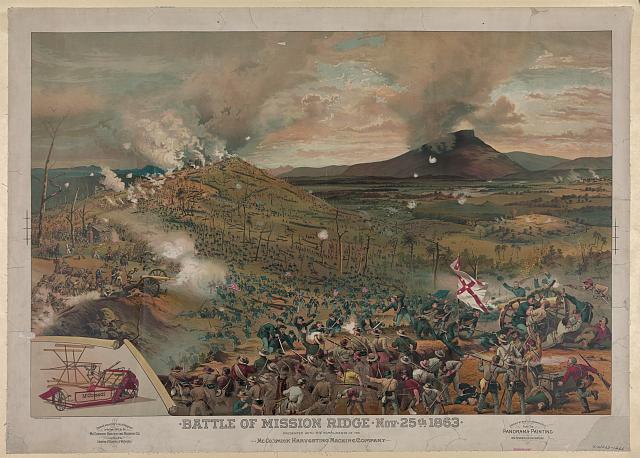
The high point of the campaign took place in late November. Chattanooga was the site of an important railroad junction that the Confederacy used to transport soldiers and supplies. Union forces sought to dislodge the Confederates from this strategic position, in order to break their supply lines and penetrate further south into Georgia. Over the course of three days between November 23rd and 25th, the Union Army took full control of the city, its railroad junction, and the Tennessee River overlook in the twin Battles of Lookout Mountain and Missionary Ridge.[31] Victory at this strategic location allowed the Union Army to enter Georgia and continue moving south toward Atlanta.
Christian was involved in the Battle of Missionary Ridge. According to testimony penned by Marshall Alley of Company B, which was published in The Hancock Democrat a few months after the battle in February 1864, Christian was one of four men from Company B detailed to act as skirmishers. They advanced up Missionary Ridge as a vanguard on the morning of the 24th and pursued Confederate skirmishers down and onto another ridge by the morning of the 25th. On that day a full artillery engagement ensued. Alley provided a romantic description of the thick of battle, which engulfed the ridges and the Tennessee and Chickamauga rivers:
“The surrounding hills and mountains smoked like so many volcanoes, and the thunders of artillery rolled along the valleys of the Tennessee. Oh, how sublime! The reverberations among the hills reminded me much of the poets’ beautiful description of ‘A Thunderstorm on the Alps.’”[32]

During the battle, Christian was “severely wounded in the thigh.” He would not survive the war. On December 17th, he died due to his wounds.[33] Christian was buried in Chattanooga with other Union soldiers who perished in nearby battles, on land that officially became the Chattanooga National Cemetery in 1867.[34] Marshall Alley described Christian as “a noble young man” who “had the love and esteem of all who knew him,” and in his correspondence published in the newspaper, Alley penned a short original poem in commemoration:
“Stern is the decree of fate which hath bound him,
And laid him to rest by stranger’s hand;
No loved ones near to weep around him,
As he sleeps alone in a stranger’s land.
It is sweet to die for one’s country.”[35]
Alley’s poem is intriguing, because it reflects the reality that many soldiers died far from home, never to see their families again, and that their remains were typically not recovered or relocated to their homes by their families or friends. When Alley wrote “a strangers land,” he was referring to Tennessee, far from Christian’s home in Indiana. But in Christian’s case, the poem had another layer of resonance, in that he was an immigrant. The country he died for was a land far from his family’s original home.
It is impossible to say what Christian’s family felt upon learning of his death in Tennessee, but it seems certain that it would have had a major impact. He was the family’s oldest child and oldest son, and the only child who crossed the Atlantic with his parents from Germany. He provided support on his father’s farm. He also appears to be one of only a few German immigrants to join the Union army from Hancock County. This was probably not an event that his parents Frederick and Louisa would have foreseen when they emigrated to the United States nineteen years before.
In October 1890, Frederick applied for a pension based on Christian’s service in the war.[36] The application was unusual, because Frederick was clearly not eligible to receive his son’s pension according to the basic application requirements. For the relative or widow of a soldier to receive a pension, they must prove that they were a financial dependent. Christian’s service may have been rewarded with a bounty payment, but there is no evidence that Frederick was ever financially dependent upon his son. It appears that the application was denied as expected, because there is no evidence that Frederick was issued a pension certificate. Maybe Frederick submitted the application because he had gotten word that other former soldiers and their relatives in Hancock County were applying for pensions. Maybe language barriers created confusion for him about the requirements. Maybe he hoped for some sort of late recompense for the loss of his child’s life. Because in a way, Christian, like other immigrant soldiers in the Civil War, had wandered into a conflict that was never his to begin with.

[1] Over time the surname has varied among descendants, and also within historical records. In Germany, the name was recorded as Oertel and Ertel (see citations to German records below), while in the U.S., many descendants use Ortel.
[2] “Germany, Select Births and Baptisms, 1558-1898,” database, Ancestry.com (https://www.ancestry.com/search/collections/9866/ : accessed 8 June 2021), entry for Christian Friedrich Oertel, baptized 17 Apr 1842, Evangelisch, Dankersen, Westfalen, Prussia.
[3] “Germany, Select Marriages, 1558-1929,” database, Ancestry.com (https://www.ancestry.com/search/collections/9870/: accessed 8 June 2021), entry for Johann Friedrich Konrad Oertel—Karoline Charlotte Luise Dehrberg, 5 May 1844, Evangelisch, Dankersen, Westfalen, Prussia.
[4] “Baltimore, Passenger Lists, 1820-1964,” database with images, Ancestry.com (https://www.ancestry.com/search/collections/8679/ : accessed 8 June 2021), entry for Oertel family [Friederich, Louise, Christian], Ship Schiller manifest, p. 4, lines 112-114, arrived Baltimore, Maryland, 23 August 1844; citing Passenger Lists of Vessels Arriving at Baltimore, Maryland, 1820-1891, microfilm publication M255, RG 36, 50 rolls (Washington, DC: National Archives and Records Administration, n.d.), roll 4.
[5] “Some of the Key Reasons Why, Centuries Ago, Germans Immigrated to America,” 26 April 2017, EMissourian.com (https://www.emissourian.com/some-of-the-key-reasons-why-centuries-ago-germans-immigrated-to-america/article_6c3fe3e5-b338-5c22-bdb9-6a1ca257bae8.html : accessed 1 July 2021).
[6] 1850 U.S. census, Hancock County, Indiana, population schedule, Sugar Creek Township, p. 474 (penned), dwelling 419, family 426, Frederick and Louisa Ortel family; image, “1850 United States Federal Census,” Ancestry.com (https://www.ancestry.com/search/collections/8054/ : accessed 20 June 2021); citing National Archives microfilm publication M432, roll 149.
[7] McCord, Beth K., Archeological Resources Management Service, “A Profile of Till Plain Archaeology: A Survey of Hancock County, Indiana, Reports of Investigation 71, Vol. 1”(Muncie, IN: Ball State University, 2007), 15-16; downloadable PDF document, Ball State University (https://cardinalscholar.bsu.edu/bitstream/handle/123456789/194933/RoI71public.pdf?sequence=1&isAllowed=y : accessed 20 June 2021).
[8] Binford, J.H., History of Hancock County, Indiana, From its Earliest Settlement by the ‘Pale Face,’ in 1818, Down to 1882” (Greenfield, Indiana: William Mitchell, 1882), 281-282; images of book pages with option to download as PDF document, “Indiana Authors and their Books,” Indiana University (http://webapp1.dlib.indiana.edu/inauthors/view?docId=VAB8229&brand=ia-books&doc.view=pagedImage&source=&image.id=VAB8229-288&query=#docView : accessed 20 June 2021).
[9] Voglebacher, Jutta and Beth K. McCord, “German Settlement,” chapter in “A Profile of Till Plane Archaeology…,” 124.
[10] For information about the Oertel family’s German cultural affiliations, see “Henry Ortel,” INGenWeb (Hancock County) (http://www.rootsquest.com/indiana/hancock/1916/ortelh.html : accessed 20 June 2021); biography transcribed from original publication and submitted by Sylvia (Rose) Duda, 8 November, 2001; entry citing George J. Richman, History of Hancock County, Indiana, Its People, Industries and Institutions (Indianapolis: B.L. Federal Publishing Co., 1916), 1069-1070. For general information about evidence of German immigrant acculturation in Sugar Creek, see Jutta Voglebacher and Beth K. McCord, “German Settlement,” chapter in “A Profile of Till Plane Archaeology…,” 127-129.
[11] 1900 U.S. census, Hancock County, Indiana, population schedule, enumeration district (ED) 51, sheet 6-B, Louesia [Ortel]; image, “1900 United States Federal Census,” Ancestry.com (https://www.ancestry.com/search/collections/7602/ : accessed 20 June 2021); citing NARA microfilm publication T623, roll 375.
[12] “Lutheran Church—Missouri Synod,” Britannica.com (britannica.com/topic/Lutheran-Church-Missouri-Synod : accessed 25 June 2021). “About Zion,” Zion Lutheran (https://www.zionnewpal.org/about-zion : accessed 1 July 2021).
[13] “Henry Ortel,” INGenWeb (Hancock County) (http://www.rootsquest.com/indiana/hancock/1916/ortelh.html : accessed 20 June 2021).
[14] Daniels, George H. “Immigrant Vote in the 1860 Election: The Case of Iowa,” Mid-America: An Historical Review 44 (July 1962): 146-162, specifically 155-157; downloadable PDF file, from “German Iowa and the Global Midwest,” University of Iowa (https://germansiniowa.files.wordpress.com/2016/09/daniels-immigrant-vote-1860.pdf : accessed 25 June 2021).
[15] Kamphoefner, Walter D. and Wolfgang Helbich, Eds., “Introduction,” Germans in the Civil War: The Letters They Wrote Home [Civil War America series] (Durham: The University of North Carolina Press, 2006), n.p. [see indicated chapter in the Kindle Edition preview on Amazon.com at https://www.amazon.com/dp/B00USC3VI8/ref=dp-kindle-redirect?_encoding=UTF8&btkr=1].
[16] Dave Leip’s Atlas of U.S. Elections, “1860 Presidential General Election Results – Indiana” (https://uselectionatlas.org/RESULTS/state.php?year=1860&fips=18&f=1&off=0&elect=0 : accessed 25 June 2021).
[17] Richman, George J. History of Hancock County, Indiana, Its People, Industries and Institutions (Indianapolis: B.L. Federal Publishing Co., 1916), 336-337; downloadable PDF (https://cdn.website-editor.net/020d9c979f77483189db333592c7de7f/files/uploaded/History%2520of%2520Hancock%2520county%252C%2520Indiana%25201916.pdf : accessed 6 July 2021).
[18] Richman, George J. History of Hancock County, Indiana, Its People, Industries and Institutions, 338.
[19] Kamphoefner, Walter D. and Wolfgang Helbich, Eds., “Introduction,” Germans in the Civil War: The Letters They Wrote Home [Civil War America series], n.p.
[20] Richman, History of Hancock County, Indiana, Its People, Industries and Institutions, 351.
[21] Richman, History of Hancock County, Indiana, Its People, Industries and Institutions, 314.
[22] 1860 U.S. census, Hancock County, Indiana, population schedule, Sugar Creek Township, p. 127 (penned), dwelling 927, family 879, Christian Ortell; image, “1860 United States Federal Census,” Ancestry.com (https://www.ancestry.com/search/collections/7667/ : accessed 25 June 2021); citing National Archives microfilm publication M653, roll 126.
[23] Kamphoefner, Walter D. and Wolfgang Helbich, Eds., “German Immigrants in the Union Army,” Germans in the Civil War: The Letters They Wrote Home [Civil War America series] (Durham: The University of North Carolina Press, 2006), n.p. [see indicated chapter in the Kindle Edition preview on Amazon.com at https://www.amazon.com/dp/B00USC3VI8/ref=dp-kindle-redirect?_encoding=UTF8&btkr=1].
[24] Kamphoefner, Walter D. and Wolfgang Helbich, Eds., “German Immigrants in the Union Army,” Germans in the Civil War: The Letters They Wrote Home [Civil War America series] (Durham: The University of North Carolina Press, 2006), n.p. [see indicated chapter in the Kindle Edition preview on Amazon.com at https://www.amazon.com/dp/B00USC3VI8/ref=dp-kindle-redirect?_encoding=UTF8&btkr=1].
[25] Richman, History of Hancock County, Indiana, Its People, Industries and Institutions, 306-307.
[26] Christian F. Ortel, Consolidated Class 1 Draft Enlistment List for the Sixth U.S. Congressional District (Hendricks, Hancock, Johnson, Marion, Morgan, and Shelby counties), August 1863, page 218 (handwritten), line 19, Sugar Creek Township, Indiana, recorded under direction of Provost Marshal D. Braden; database with images, “U.S., Civil War Draft Registrations Records, 1863-1865,” Ancestry (https://www.ancestry.com/search/collections/1666/ > Indiana > 6th > Vol. 5 : accessed 30 June 2021); citing War Department, Provost Marshal General’s Bureau, Consolidated Lists of Civil War Draft Registrations, 1863-1865, Record Group 110, NARA, Washington, D.C. The printed text header at top of the page was modified by hand to read “Class III comprises all persons in the military service between ages of twenty and forty-five years, March 3, 1863.” According to the NARA database listing for these records, Class III lists were for Union Army volunteers.
[27] “Excerpts from ‘The New History of the 99th Indiana Infantry’ by Chaplain D.R. Lucas,” Ed. Paul A. Boccadoro, The Liberty Rifles (https://www.libertyrifles.org/research/regiments/99th-indiana : accessed 30 June 2021).
[28] 1860 U.S. census, Hancock Co., In., pop. sch., Sugar Creek Township, p. 127 (penned), dwell. 927, fam. 879, Ortell family.
[29] “The Civil War,” Genealogy Trails History Group, Hancock County, Indiana (http://genealogytrails.com/ind/hancock/civil-war.html : accessed 30 June 2021). See paragraph with heading “Ninety-Nineth Regiment, Indiana Volunteers,” for a listing of members of Company B. It is not certain that Christian was the only German immigrant or child of German immigrants in his company. There are members with surnames like Nibarger, Myers, and Youse, which may be of German origin; however, the first names of these individuals are not typically German, which makes it likely that Christian was the only immigrant or first-generation member of Company B.
[30] “Union Regimental Histories, Indiana,” Civil War Archive (http://www.civilwararchive.com/Unreghst/unininf7.htm#99th : accessed 30 June 2021). See section titled “99th Regiment Infantry.”
[31] The Editors of Encyclopaedia Britannica, “Battle of Chattanooga,” Britannica (https://www.britannica.com/event/Battle-of-Chattanooga : accessed 30 June 2021).
[32] Marshal Alley (Co. B), “Correspondence of the 99th Ind., Scottsborough, Ala., Sunday, January 10th, 1864,”The Hancock Democrat (Greenfield, Indiana), 4 February 1864, p. 1., col. 4-6; image, Newspapers.com (https://www.newspapers.com/ : accessed 30 June 2021).
[33] Alley (Co. B), “Correspondence of the 99th Ind., Scottsborough, Ala., Sunday, January 10th, 1864,”The Hancock Democrat, 4 February 1864.
[34] “U.S., National Cemetery Interment Control Forms, 1928-1962,” card for Christian Ortell, database with images arranged alphabetically by surname, Ancestry.com (https://www.ancestry.com/imageviewer/collections/2590/images/40479_2421406259_0432-03321?pId=1637739 : accessed 30 June 2021); citing “Interment Control Forms, 1928-1962,” Record Group 92: Records of the Office of the Quartermaster General, 1774-1985, National Archives at College Park, Maryland. “Chattanooga National Cemetery,” Wikipedia (https://en.wikipedia.org/wiki/Chattanooga_National_Cemetery : accessed 30 June 2021).
[35] Alley (Co. B), “Correspondence of the 99th Ind., Scottsborough, Ala., Sunday, January 10th, 1864,”The Hancock Democrat, 4 February 1864.
[36] Christian Ortel (Co. B, 99th Ind. Inf, Civil War), Index [card] to Pension File, father’s pension application no. 483795, no certificate number noted; image, “Civil War Pensions Index,” Fold3 (https://www.fold3.com/image/361965 : accessed 30 June 2021); citing Civil War Pensions, Organization Index to Pension Files of Veterans Who Served Between 1861 and 1900, Record Group 15: Records of the Department of Veterans Affairs, 1773-2007; National Archives, Washington D.C. “Union Pension Records,” Wikipedia (https://www.familysearch.org/wiki/en/Union_Pension_Records : accessed 30 June 2021).
Leave a Reply